OpenQuantumSim
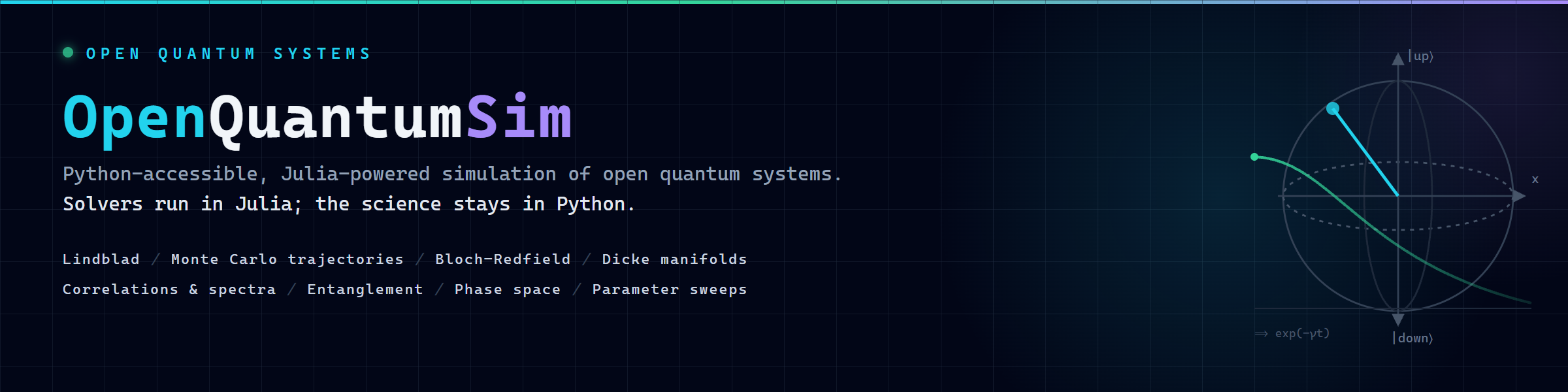
OpenQuantumSim is a Python interface with a Julia backend for open quantum system simulation. It is aimed at researchers who need Lindblad propagation, Monte Carlo wave-function trajectories, Bloch-Redfield weak-coupling dynamics, collective-spin/Dicke models, restartable sweeps, HDF5 outputs, and state diagnostics without leaving the Python scientific stack.
One import, no glue code.
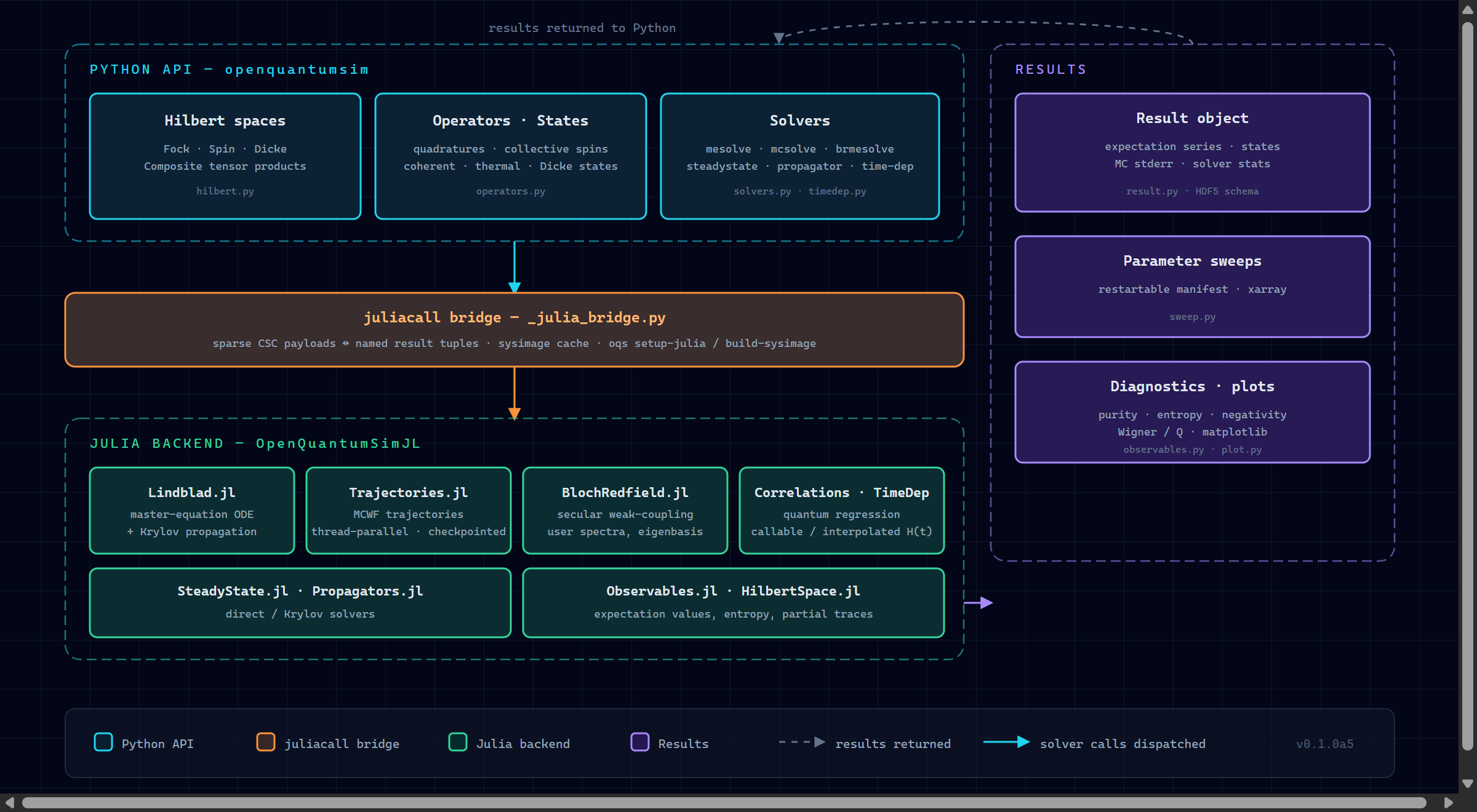
import openquantumsim as oqsgives the full API: spaces, operators, solvers, diagnostics, plotting, and persistence.Julia speed, Python ergonomics. Propagation runs in the packaged
OpenQuantumSimJLbackend; arrays go in, named results come back.Validated, not just benchmarked. Analytic limits and QuTiP reference models are checked in CI on Linux and Windows.
Get started with the Quick Start, browse the Example Gallery, or jump
straight to the API Reference. The package is currently an alpha: the
API is usable, tested, and published on PyPI, but minor interface changes may
still occur before a stable 0.1 release. The solver entry points, the
Result object, and the HDF5 result schema are stable-in-practice; see the
README for the road to 0.1.0.
If you use OpenQuantumSim in your research, please cite the software release —
see the repository CITATION.cff.
Getting Started
Background
- Theory Notes
- Validation Gallery
- Performance Benchmarks
- Benchmark Environment
- Deterministic Solver: OpenQuantumSim vs QuTiP
- Python Wrapper Profile
- Backend Startup Profile
- Local Sysimage Startup
- Larger Deterministic Spot Checks
- Monte Carlo Wave Functions: OpenQuantumSim vs QuTiP
- Monte Carlo Wave Function Scaling
- Dicke Mutual-Information Batch Runner
- Sparse Scaling (Hilbert Dimensions 512-2048)
- Reproducing Results
- Case Studies