Performance Benchmarks
This page records a reproducible OpenQuantumSim performance baseline. The numbers below are not a universal leaderboard; they document one hardware and software configuration so future benchmark results can be compared against the same reference point.
Benchmark Environment
Item |
Value |
|---|---|
Date |
2026-05-22 |
OpenQuantumSim commit |
startup optimization snapshot |
CPU |
Apple M1 |
Logical CPU count |
8 |
Platform |
macOS 26.4.1 arm64 |
Python |
3.14.3 |
Julia backend runtime |
1.11.9 through JuliaCall |
|
1.12.5 |
OpenQuantumSim |
0.1.0a2 |
QuTiP |
5.2.3 |
NumPy / SciPy / h5py |
2.4.4 / 1.17.1 / 3.16.0 |
Deterministic Solver: OpenQuantumSim vs QuTiP
Command:
MPLCONFIGDIR=/private/tmp/oqs-mpl \
python benchmarks/bench_vs_qutip.py \
    --repeats 5 \
    --time-points 81 \
    --t-final 6.0 \
    --cases qubit jc5 jc10 \
    --oqs-methods auto krylov ode \
    --json runs/benchmarks/bench_vs_qutip_after_stats.json
Settings: rtol=1e-8, atol=1e-10. OpenQuantumSim used the default
single-threaded backend process for this deterministic benchmark.
Case |
Dimension |
QuTiP median |
OQS auto median |
Best OQS median |
OQS auto vs QuTiP |
Max expectation delta |
|---|---|---|---|---|---|---|
Qubit decay |
2 |
1.43 ms |
1.00 ms |
0.77 ms ( |
1.42x |
7.49e-09 |
Jaynes-Cummings 5 |
10 |
2.18 ms |
1.14 ms |
1.14 ms ( |
1.90x |
1.21e-09 |
Jaynes-Cummings 10 |
20 |
6.71 ms |
2.60 ms |
2.08 ms ( |
2.58x |
7.23e-09 |
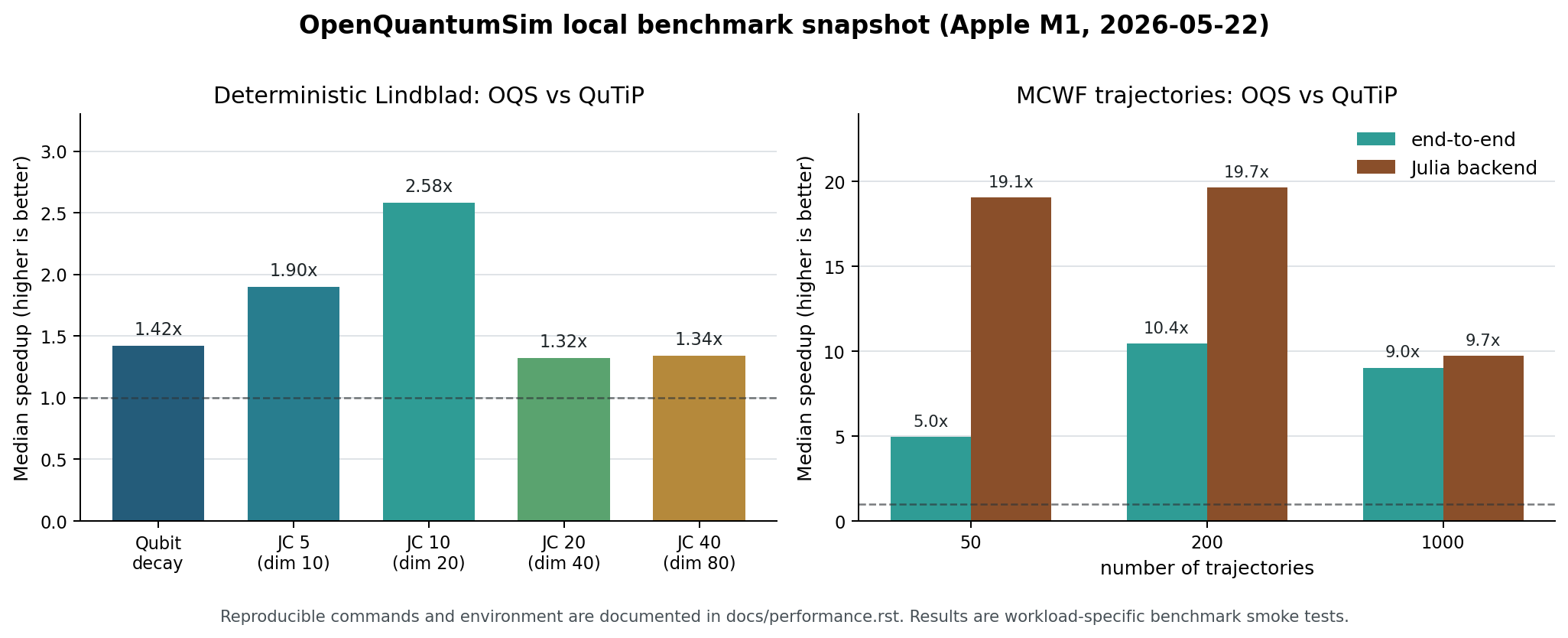
Interpretation: after reducing solver-stat conversion overhead at the
Python-Julia boundary, OpenQuantumSim is faster than QuTiP for these small
deterministic benchmark cases on this machine. Expectation values agree with
QuTiP at about 1e-9 to 1e-8.
Python Wrapper Profile
The main small-system bottleneck was not the Julia integrator. It was repeated
Python-side probing of optional fields in the Julia NamedTuple used for
Result.solver_stats. The conversion now uses the fields reported by
dir(...) and avoids exception-heavy lookups for fields that are not present.
Profile |
Workload |
Python-visible cumulative time |
Solver-stat conversion time |
|---|---|---|---|
Before |
100 warm qubit-decay |
0.671 s |
0.601 s |
After |
100 warm qubit-decay |
0.050 s |
0.007 s |
Backend Startup Profile
Command:
PYTHON_JULIACALL_HANDLE_SIGNALS=yes python - <<'PY'
import time
import numpy as np
import openquantumsim as oqs
from openquantumsim._julia_bridge import get_julia, load_backend

started = time.perf_counter(); get_julia()
print("get_julia", time.perf_counter() - started)
started = time.perf_counter(); load_backend()
print("load_backend", time.perf_counter() - started)

space = oqs.SpinSpace(0.5, label="atom")
psi = oqs.basis(space, "up")
H = 0.0 * oqs.sigmaz(space)
c = np.sqrt(0.35) * oqs.sigmam(space)
e = oqs.Operator(oqs.ket2dm(psi), space, "P_excited")
t = np.linspace(0.0, 1.0, 11)

started = time.perf_counter()
oqs.mesolve(H, oqs.ket2dm(psi), t, c_ops=[c], e_ops=[e])
print("first_mesolve", time.perf_counter() - started)
PY
The profile below measures a fresh Python process after the Julia backend has
already been set up once. Normal runtime loads now skip Pkg.instantiate()
unless loading the backend fails; oqs setup-julia still forces
instantiation for installation validation.
Profile |
|
|
|
First |
Total |
|---|---|---|---|---|---|
Before |
0.786 s |
2.602 s |
11.337 s |
7.775 s |
22.500 s |
After |
0.334 s |
3.005 s |
6.139 s |
7.816 s |
17.294 s |
The same change also suppresses routine Julia package-manager output during normal solver calls.
Local Sysimage Startup
For repeated solver sessions, oqs build-sysimage compiles the packaged Julia
backend into a local sysimage and validates it with a fresh JuliaCall process
before it is registered for automatic reuse.
Command:
python benchmarks/bench_startup_sysimage.py \
    --install-local . \
    --repeats 1 \
    --json runs/benchmarks/bench_startup_sysimage_0.1.0a5_m1_2026-05-27.json
Apple M1, Python 3.14.3, Julia 1.11.9, single Julia thread:
Profile |
|
|
First |
Total |
|---|---|---|---|---|
Cold, no setup |
17.465 s |
20.773 s |
20.336 s |
72.315 s |
Warm, no sysimage |
2.301 s |
10.407 s |
13.711 s |
26.940 s |
Warm, validated sysimage |
4.756 s |
3.570 s |
3.894 s |
12.767 s |
The sysimage build took 692.064 s and produced a 543 MB image on this machine. The warm sysimage profile was 2.1x faster end-to-end than warm startup without a sysimage, with the first solver call itself 3.5x faster.
Larger Deterministic Spot Checks
Command:
MPLBACKEND=Agg PYTHON_JULIACALL_HANDLE_SIGNALS=yes \
python benchmarks/bench_vs_qutip.py \
    --repeats 3 \
    --time-points 81 \
    --t-final 6.0 \
    --cases jc20 jc40 \
    --oqs-methods auto ode krylov \
    --json runs/benchmarks/bench_vs_qutip_larger_startup_patch.json
Case |
Dimension |
QuTiP median |
OQS auto median |
Best OQS median |
OQS auto vs QuTiP |
Max expectation delta |
|---|---|---|---|---|---|---|
Jaynes-Cummings 20 |
40 |
3.91 ms |
2.95 ms |
2.95 ms ( |
1.32x |
1.96e-08 |
Jaynes-Cummings 40 |
80 |
13.93 ms |
10.38 ms |
8.52 ms ( |
1.34x |
4.71e-08 |
Monte Carlo Wave Functions: OpenQuantumSim vs QuTiP
Command:
PYTHON_JULIACALL_HANDLE_SIGNALS=yes JULIA_NUM_THREADS=4 \
python benchmarks/bench_mcsolve_vs_qutip.py \
    --n-traj 50 200 1000 \
    --time-points 31 \
    --t-final 2.0 \
    --max-step 0.02 \
    --repeats 3 \
    --json runs/benchmarks/bench_mcsolve_vs_qutip_m1_2026-05-22.json
Settings: spontaneous-emission qubit, gamma=0.35, one excited-state
projector, QuTiP mcsolve with progress disabled, OpenQuantumSim mcsolve
with n_jobs=-1 and four Julia threads.
Trajectories |
QuTiP median |
OQS median |
OQS backend wall time |
Workers |
OQS vs QuTiP |
OQS backend vs QuTiP |
|---|---|---|---|---|---|---|
50 |
8.85 ms |
1.79 ms |
0.46 ms |
4 |
4.96x |
19.06x |
200 |
33.58 ms |
3.22 ms |
1.71 ms |
4 |
10.44x |
19.67x |
1000 |
168.01 ms |
18.60 ms |
17.25 ms |
4 |
9.03x |
9.74x |
Interpretation: for this MCWF smoke benchmark, threaded backend-side aggregation gives OpenQuantumSim a clear trajectory-throughput advantage over QuTiP after backend warmup. The exact speedup is workload-specific and should be re-measured for larger Hilbert spaces and more expensive observables.
Monte Carlo Wave Function Scaling
Command:
JULIA_NUM_THREADS=4 MPLCONFIGDIR=/private/tmp/oqs-mpl \
python benchmarks/bench_mcsolve.py \
    --n-traj 200 \
    --time-points 31 \
    --t-final 2.0 \
    --max-step 0.02 \
    --repeats 3 \
    --warmup-trajectories 10 \
    --n-jobs 1 -1 \
    --json runs/benchmarks/bench_mcsolve_m1_2026-05-14.json
|
Workers |
Threaded |
Median elapsed |
Backend wall time |
Speedup vs serial |
Max expectation delta |
|---|---|---|---|---|---|---|
1 |
1 |
False |
6.595 ms |
3.868 ms |
1.00x |
1.00e-02 |
-1 |
4 |
True |
4.092 ms |
1.542 ms |
1.61x |
1.00e-02 |
Interpretation: backend-side trajectory aggregation and threading work. The small benchmark shows useful scaling, though the wall time is still heavily affected by Python-call overhead at this size. Larger trajectory counts should give a clearer measure of Julia-side scaling.
Dicke Mutual-Information Batch Runner
Command:
JULIA_NUM_THREADS=1 MPLCONFIGDIR=/private/tmp/oqs-mpl \
python examples/dicke/bench_mi.py \
    --N 4 \
    --kappa 0.1 \
    --n-traj 12 \
    --time-points 21 \
    --t-final 0.2 \
    --max-step 0.02 \
    --batch-size 2 \
    --repeats 2 \
    --warmup-trajectories 1 \
    --n-jobs 1 2 \
    --target-n-traj 1000 \
    --json runs/benchmarks/bench_dicke_mi_m1_2026-05-14.json
|
Workers |
Median elapsed |
Trajectories / s |
Seconds / trajectory |
Speedup vs serial |
|---|---|---|---|---|---|
1 |
1 |
0.0836 s |
143.46 |
0.0070 |
1.00x |
2 |
2 |
19.7627 s |
0.607 |
1.6469 |
0.004x |
Interpretation: this small Dicke MI benchmark exposes process-startup overhead. Each short-lived worker initializes its own Julia backend, so process parallelism is slower for small batches. Larger batches better amortize startup costs.
Sparse Scaling (Hilbert Dimensions 512-2048)
benchmarks/bench_sparse_scaling.py measures mesolve on nearest-neighbour
spin chains with local amplitude damping, where the Hamiltonian and collapse
operators are sparse and the dimension grows as 2**n_spins. QuTiP timings
are included when QuTiP is installed.
Warm timings on a Windows 11 desktop (2026-09-30, backend precompiled;
OpenQuantumSim 0.1.0a6 vs QuTiP 5.3.1; 21 time points, t_final=5,
rtol=1e-6, atol=1e-8):
Case |
Hilbert dim |
OpenQuantumSim |
QuTiP |
Speedup |
max abs delta expect |
|---|---|---|---|---|---|
spin9 |
512 |
9.19 s |
6.70 s |
0.73x |
1.2e-08 |
spin10 |
1024 |
75.9 s |
51.2 s |
0.68x |
1.7e-08 |
Both engines agree to about 1e-8. Interpretation: the OpenQuantumSim
advantage documented for the dense reference cases (dimension up to 80) does
not carry over to these sparse spin-chain cases at dimension 512-1024, where
QuTiP is currently faster. Run the script yourself to reproduce or challenge
these numbers:
python benchmarks/bench_sparse_scaling.py --cases spin9 spin10 --json runs/sparse_scaling.json
Note
Solving at dimension 2048 (spin11) needs several GB of free RAM for
dense state storage; avoid running it alongside other workloads.
Reproducing Results
The raw JSON outputs are generated under runs/benchmarks/ and are ignored by
Git. Re-run the commands above to regenerate the local benchmark artifacts.